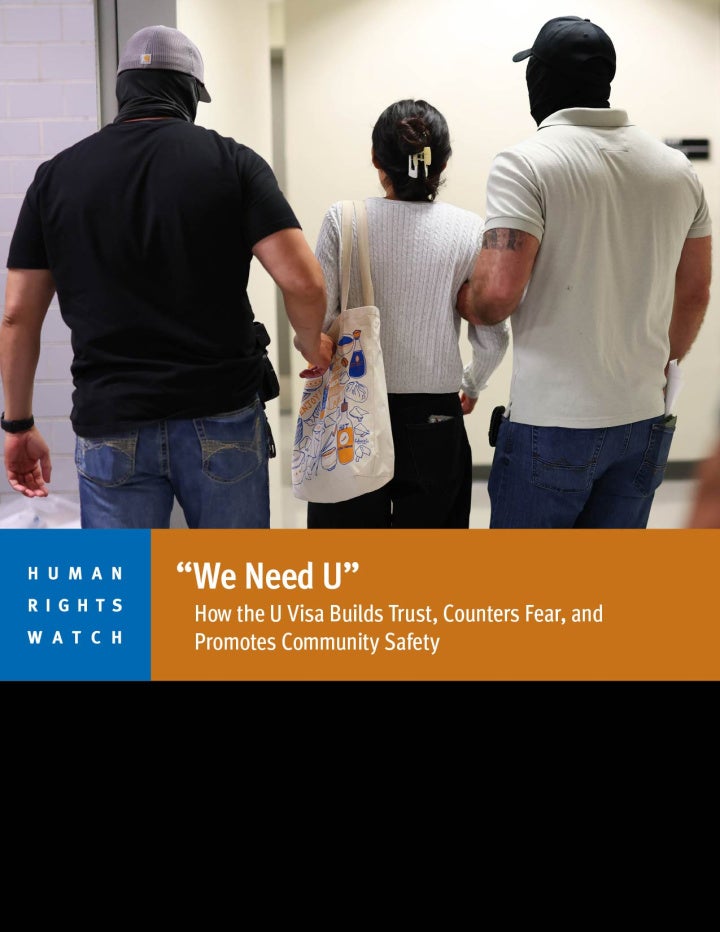
How the U Visa Builds Trust, Counters Fear, and Promotes Community Safety
The 50-page report, “‘We Need U’: How the U Visa Builds Trust, Counters Fear, and Promotes Community Safety,” finds that the administration’s deportation policies undermine federal visa programs that provide a pathway for crime victims to obtain legal residency when they cooperate with law enforcement. Changed enforcement guidance, such as allowing Immigration Customs Enforcement (ICE) officials to apprehend people in previously safe places like courthouses and health centers, is a strong deterrent for immigrants who might otherwise report crime to police or seek a protective order.
Why the International Community Should Reject Australia's Refugee Policies
The government of Australia has taken increasingly aggressive measures in recent years to prevent unauthorized asylum seekers from reaching its shores. One year ago, on September 26, 2001, it enacted new legislation that extended the legal basis for its policies, which are among the most restrictive in the developed world.
The Arbitrary Application of Spanish Immigration Law
The Human Rights Watch report, "Discretion Without Bounds: The Arbitrary Implementation of Spanish Immigration Law," criticizes the Spanish authorities' uncoordinated and ad hoc application of Spanish Law 8/2000.
State Abuses of Unaccompanied Migrant Children by Spain and Morocco
Moroccan migrant children in Spain are frequently beaten by police and abused by staff and other children in overcrowded, unsanitary residential centers, Human Rights Watch charged in this report. Spain also summarily expels children as young as eleven to Morocco, where Moroccan policebeat and ill-treat them and then abandon them to the streets.
Women in Guatemala's largest female-dominated labor sectors face persistent sex discrimination and abuse, Human Rights Watch charges in this report. The 147-page report examines two sectors, export processing and private households, which employ tens of thousands of women sewing clothes for sale in the United States and working as live-in domestic workers.
The Impact of the September 11 Attacks on Refugees, Asylum Seekers and Migrants in the Afghanistan Region and Worldwide
The backlash against refugees, asylum seekers and migrants throughout the world is a serious side effect of the September 11 attacks. While governments have legitimate security concerns, there must be a balance with human rights and refugee protection standards.
Backgrounder for the World Conference against Racism, Racial Discrimination, Xenophobia and Related Intolerance
Throughout the world, refugees, asylum seekers, migrants and internally displaced persons are the victims of racial discrimination, racist attacks, xenophobia and ethnic intolerance. Racism is both a cause and a product of forced displacement, and an obstacle to its solution.
Proposed Amendments to the 12 July 2001 Draft Programme of Action For Equality and Non-Discrimination Against Racism, Racial Discrimination, Xenophobia, and Related Intolerance (A/CONF.189/PC.3/8) and the Draft Declaration (A/CONF.189/PC.3/7).
Hundreds of thousands of Sierra Leonean and Liberian refugees along Guinea's border were relocated from the embattled border area in early 2001 to camps in the interior of the country. While the organized movement from the border is a welcome and long overdue step, the long-term safety of the refugees is still under threat.
The Rwandan government has violated the basic rights of tens of thousands of people by forcing them to abandon their homes in rural areas and move to makeshift dwellings in government-designated sites, Human Rights Watch charges in this report.
The Greek Government should as a matter of urgency take measures to alleviate the extreme overcrowding and otherappalling conditions of detention for foreigners held in police facilities in Greece.
How countries treat those who have been forced to flee persecution and human rights abuse elsewhere is a litmus test of their commitment to defending human rights and upholding humanitarian values.
The November 24-25 summit in Zagreb, with the participation of fifteen European Union (E.U.) states and Albania, Bosnia and Herzegovina, Croatia, Federal Republic of Yugoslavia, the former Yugoslav Republic of Macedonia and Slovenia, provides a unique opportunity for the E.U.
Although the government of Burundi has promised Nelson Mandela that it will close its squalid "regroupment" camps, that promise has not yet been fulfilled, Human Rights Watch charged in this report. The former South African president is leading a new round of the Burundi peace talks, opening tomorrow.
Every recognized country in the world, except for the United States and the collapsed state of Somalia, has ratified the Convention on the Rights of the Child, pledging to uphold its protections for children. Today the convention stands as the single most widely ratified treaty in existence.